I Wasn't Overwhelmed, I Was Exhausted From Pretending I Wasn't
6 min read
I thought I was strong. I was. But somewhere along the way, strength became the thing I hid behind and it almost cost me everything that mattered.
There is a particular kind of exhaustion that doesn’t show up on your face.
It doesn’t cancel your plans or call in sick or ask for help. It shows up dressed and on time. It remembers everyone’s appointments, decorates for the birthday, makes the day feel special. It boards the plane when it needs to and holds it together when it has to and keeps moving because stopping, even for a moment, feels like a luxury it can’t afford.
I know this exhaustion intimately. I built it, brick by brick, over the better part of my life.
By the end of March, I could no longer pretend I hadn’t.
My son turned ten early in March. A whole decade of keeping a human alive. Which, if nobody has told you lately, deserves its own trophy. I decorated. I planned. I made the day feel like the milestone it was. That weekend, we did his birthday sleepover at a hotel with his friends loud and joyful and exactly what a ten-year-old boy’s celebration should be.
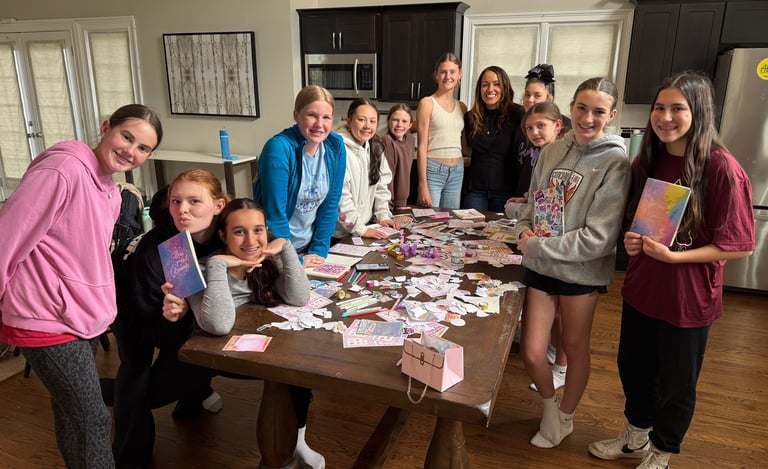
A week later, I stood in front of a room of Girl Scouts, twelve and thirteen years old, and spoke about the power of their words.
I told them that journaling isn’t a hobby, it’s a practice of self-preservation. That their inner voice matters. Writing things down is how you learn to trust yourself. How you build a relationship with the person you’ll spend your entire life becoming.
And as I said it, something confirmed itself quietly in my chest.
This is what I’m supposed to be doing.
Because I wasn’t just speaking to them. I was speaking to her, the girl I used to be, growing up in the 90s with a diary tucked somewhere safe, writing down everything I couldn’t yet say out loud. We called it a diary back then, not journaling and we kept it locked because what lived inside it was too real, too tender, too ours to leave unprotected. Never mind that any determined sibling (or parent) could crack that lock with a bobby pin and zero effort. The point was, it was ours.
Nobody stood in front of me at twelve and told me that what I was doing was powerful. That the words I was writing to myself were building something. That one day, that practice would hold me together in ways nothing else could.
So I stood in front of those girls and said it to both of us.
I left that room knowing I needed to reach more of them.
What I didn’t yet know was that the season ahead was about to ask me to practice everything I’d just preached.
My aunt got sick shortly after.
Eight days later, my 40th birthday was supposed to be a beach trip. My people, a celebration years in the making. Instead, I got on a plane to New York.
On Easter Sunday, she passed away.
In between, life didn’t slow down to acknowledge any of it. My son broke his wrist the first Friday of spring break. Responsibilities continued. Routines continued. The things that needed me kept needing me because that is the nature of being needed, it doesn’t consult your calendar or consider your capacity.
There was no space to fall apart.
So I didn’t.
I want you to sit with that. Not the grief, not the loss, not the accumulated weight of that season but the fact that I had become so used to not falling apart that I had stopped noticing what it was costing me. That I had spent so many years being the reliable one, the steady one, the one who keeps things moving, that I had quietly built a life with no room in it for my own unraveling.
As the eldest daughter, you learn early. You learn that your job is to hold the center. That falling apart is a disruption, not a need. That strength is not something you feel, it’s something you perform, consistently, for everyone around you, until the performance becomes so practiced you forget it’s one at all.
What I didn’t see, what I couldn’t see, until this season forced me to was that buried inside that identity was a quiet, non-negotiable requirement:
Abandon yourself as needed.
Don’t take up too much space with your own needs. Don’t let the seams show, don’t make it harder for everyone else by making your hard visible.
That’s not strength.
That’s shrinking with better posture.
At some point during those weeks, I sat across from my ten-year-old son and said, “Mommy isn’t okay.”
I didn’t fix it. I didn’t soften it. I didn’t follow it with a reassurance or a pivot or a plan which, if you know me, is basically my love language. I just told the truth and let it be true.
That moment clarified something I had been circling for years. Because the version of strength I had been performing. Which requires you to manage how you appear, to absorb without acknowledging, to give without ever naming what you need has a ceiling. And life, eventually, will find it.
There were days I didn’t cook. Laundry piled up. Things that normally anchored me lost their pull.
I didn’t stop caring. I finally stopped pretending I wasn’t carrying something heavy.
Grief. Pressure. Responsibility. The quiet terror of turning 40 in an airport instead of on a beach, and realizing that even your grief has to get in line.
Somewhere in the middle of all of it, I made a different decision. I stopped managing how things looked and started paying attention to what I actually needed. That shift sounds simple. It was not. It is perhaps the hardest thing a woman who has built her life around being needed can do, turn that same careful attention toward herself. Without guilt. Without apology. Without immediately making it productive.
And listen, I tried to make it productive. I am who I am.
But here is what I know now, discernment isn’t weakness. It is one of the most underused forms of intelligence a woman can practice. Knowing what you actually need and choosing it anyway, is not self-indulgence. It is the foundation. The thing everything else has to be built on, or eventually, nothing stands.
I was sitting in a nail salon the day before I flew to New York. My birthday weekend. The technician asked me what design I wanted.
If you know me, you know this question typically convenes a full internal committee. There are options to consider, aesthetics to weigh, the occasion to factor in. I take my nails seriously. Don’t judge me.
But for the first time in longer than I could account for, my mind went quiet.
I chose a soft pink.
Simple. Clean. Enough.
Something settled in me when I did, a stillness I hadn’t felt in weeks. I chose that color as a reminder. To come back to myself. To give myself the love I had been pouring into everyone else. To get grounded when life made it hard to stand still. It wasn’t a grand gesture. It was a quiet decision to stop putting myself last on my own list.
I told myself: let this be the standard.
Not perfect. Not overdone. Not performative.
Just honest.
So I want to ask you something and I don’t mean this as inspiration, but as a genuine question worth sitting with long after you’ve finished reading:
Where are you performing strength?
Not where you are strong. I already know you’re strong. But where has your strength become a costume, something you put on each morning so that no one, including yourself, has to reckon with what’s actually underneath it? Where are you abandoning yourself in order to maintain the image of a woman who doesn’t need to be held?
The Girl Scouts in that room back in March reminded me of something I had almost let myself forget. That little girl from the 90s with the locked diary, she already knew. She knew her words were worth protecting. That what she felt deserved a place to live. She was building something even then, even without anyone telling her so.
This season asked me to finally become her answer.
Soft pink. Simple. Clean. Enough.
A color that means: come back to yourself. Love yourself where you are. Get grounded and stay.
That is the standard now not just for my nails, but for the way I move through my life. This season shifted something in me. I have no intention of un-shifting, I have arrived at that, Permanently.
And if you are somewhere in the middle of your own season right now, still holding it together, still performing, still making yourself smaller so everything else can feel bigger, I am not going to tell you it gets easier.
I am going to tell you it gets clearer.
And clarity, once it finds you, doesn’t let go.
Let’s rise together.
Diana A. Hampton